M-KOPA’s journey towards profitability was neither short nor linear. The company patiently focused on building the business, taking over 14 years to achieve profitability, while repeatedly testing new products, adapting its business model, and learning from how customers responded in practice.
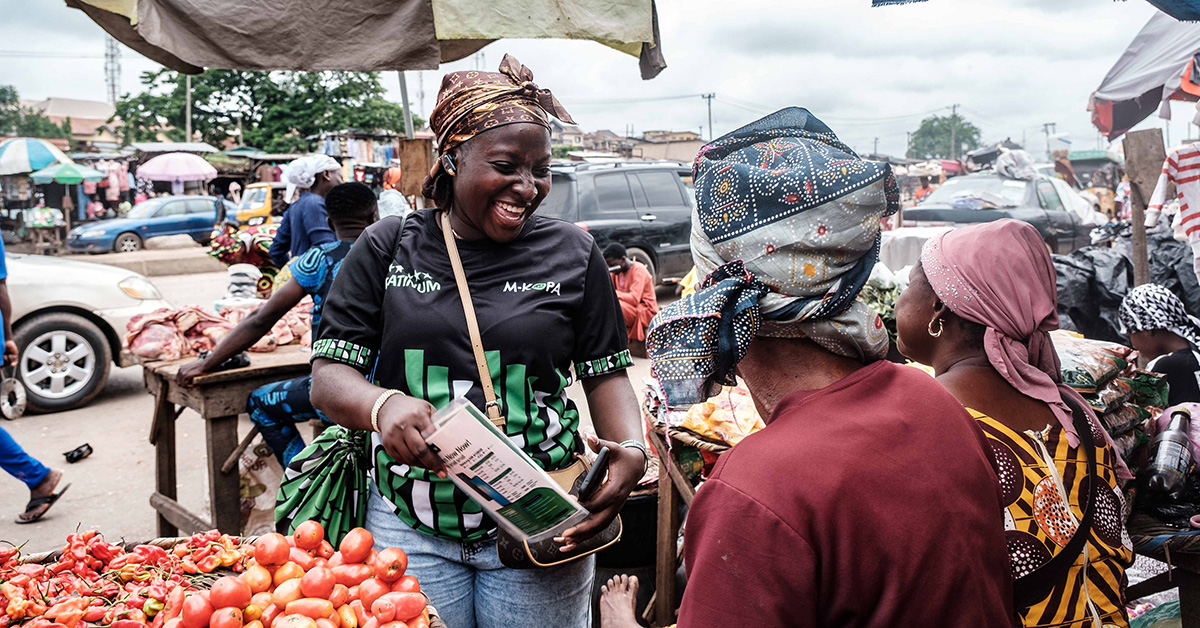
Today, M-KOPA is a pan-African fintech providing asset finance and digital financial services to people it calls “Everyday Earners”: economically active customers whose incomes often come from informal or daily work and who may lack the salaries, collateral or credit histories required by conventional lenders. Its aim is to enable what the company calls financial progress by giving customers access to useful assets and services on terms structured around how they actually earn.
That proposition has evolved considerably. M-KOPA began in Kenya with pay-as-you-go solar lighting, before moving into products including televisions and fridges, smartphone financing and, more recently, electric-motorbike finance. Smartphones now provide the main entry point to a wider range of services that M-KOPA provides, including digital loans, affordable data, device protection, and health insurance.
One experiment within that longer journey was supported by PREO. Beginning in Kenya in 2020, the Micro-Biz Bundle tested a combined pay-as-you-go offer for rural microbusiness owners comprising a solar home system, smartphone and e-voucher.
PREO spoke to M-KOPA Chief Product Officer, Nena Sanderson, about what that the project revealed, how the company sustained the confidence of investors and its team through a long and sometimes difficult journey, and what earlier-stage PURE companies can learn from M-KOPA’s experience of testing, adapting and building towards profitable scale.
M-KOPA’s product offering has changed considerably. What has remained constant beneath that evolution?
From inside the company, the core mission and vision have held constant. We were founded around enabling financial progress for people we now call everyday earners.
These are people who operate in the informal economy. They may not have a bank account, pay slips or a monthly salary, but they are hugely active in the economy. Their access to financial services is often very limited because the financial system was not designed around the day-to-day reality of their lives.
We have iterated on the product offering and, in some cases, the business model. What has stayed the same is the problem we are trying to solve: how to provide products and financial services differently for everyday earners, in a way that matches how they live and work.
For one customer, financial progress may come from a solar home system that allows them to work later. For another, it may be a smartphone that connects them to customers and suppliers, a motorbike that provides income or a digital loan that supplies working capital.
The products can look quite different, but the thread running through them is whether they can help customers make financial progress in their lives.
Where did PREO and grant-funded experimentation fit into that journey, and what did the Micro-Biz Bundle teach you?
Research and development grants have been a really valuable asset to M-KOPA. They allow you to experiment with an idea that may have significant potential but does not yet have a fully developed business plan or a clear effect on the profit-and-loss account today.
That mattered when we were pushing hard for scale and profitability. Internal capital had to be allocated carefully. PREO gave us the space and capital to test a new idea in practice and build evidence around its commercial potential before committing greater resources to scaling it.
In our markets, there is often a blurred line between an individual consumer and a small-business owner. Many customers buy a product personally but also use it to generate income. The Micro-Biz Bundle focused on rural microbusiness owners and tried to address several connected needs at once. The solar system provided power. The smartphone offered connectivity and a tool for interacting with customers and suppliers, making M-PESA payments, and accessing information. The voucher gave customers purchasing capacity for stock, agricultural inputs, or other needs. We saw strong demand and very positive customer sentiment. But the total loan amount and daily repayment for all three products together started to stretch affordability for some customers.
That reinforced a lesson we have learned several times: what customers say and what they really do with their money are not always the same thing. A customer may genuinely value every element and believe they can afford it. But commercial viability depends on actual payment behaviour.
Customers did not always use the products as the project design anticipated. The solar system might be installed at home. The smartphone was used for business and personal purposes. Vouchers intended mainly for stock or agricultural inputs were also used for household goods.
That did not necessarily mean the voucher had no business effect. An important household purchase might release the customer’s own cash for business use. Customers do not always separate household and business spending in the way we might when designing a pilot. They are deciding where the money will have the greatest impact across their lives.
The broader idea of bundling had legs, but the full package was too expensive for some customers. We continued to iterate on the bundling proposition. Today, a financed M-KOPA smartphone comes with bundled data, device protection or health cover, and access to digital loans after positive repayment.
The experiment helped us understand the value customers saw in combining products and services, and the need to make the proposition more focused and affordable.
What did the long journey towards profitability require from the business and its investors?
We are very proud to be profitable today because it demonstrates that the mission can be pursued in a commercially sustainable and deeply scalable way. And it was a long road to get here. M-KOPA went through roughly fifty unprofitable quarters before reaching its first profitable one.
This required patience from the founders and particularly from our early investors. They had to believe in the long-term journey, the mission and the underlying unit economics before the company-level accounts showed a profit.
Long before the whole company was profitable, we could look at individual customer cohorts. If you offer customers a loan, will they repay it? How quickly do they need to repay for the company to recover its investment? What pricing and credit performance do you need?
You can then layer in the costs of operating in a market, running the wider group and the efficiencies that may come through scale. That gives you a clearer view of the break-even point and how resilient the model will be when macroeconomic shocks occur.
Cost discipline and credit discipline were crucial. It is easy to make a short-term trade-off that produces an attractive growth number: reduce the deposit, offer a promotion or price aggressively. Those numbers may look compelling to investors, but they do not always produce the portfolio performance needed for a profitable and scalable company. There were times when we accepted that we would not win every sale because we would not price unsustainably. We were focused on building a large business that would be here for the long term.
The same realism matters in how you communicate with investors. You can promise the world and fall into a cycle of overpromising and underdelivering. It is better to give an optimistic but sober account of where the business is, the risks it faces, and what management is doing about them.
Some investors have said that one of M-KOPA’s strengths is how the company responds to a crisis. Many companies can produce a beautiful pitch deck. Confidence is built differently when investors have seen the team go through difficult moments, find a creative solution, and keep moving.
How did you keep the team steady and preserve an experimental culture as M-KOPA grew?
We have always tried to build the culture around the mission, the customer and the value we want to create in customers’ lives. We are explicit about that when hiring. If someone is looking only for the shortest-term payoff or the highest salary in the market, M-KOPA may not necessarily be the place for them. The reason to join is that you believe in the mission, care about the team and want to build something that really matters over the long term.
But you cannot simply sell the dream every day and keep telling people that you are almost there. It is important to be honest and frank with the team: this is where we are, these are the real challenges, and this is what we need to solve.
When leaders do that, people can feel that they are genuinely in it with you. They can take pride in doing difficult things, particularly when those things matter and have a visible impact on customers’ lives. Our values help us make that practical. One of our values is progress every day. We do not expect ourselves to be perfect; what matters is that we keep improving.
The second is excellence where it counts. As M-KOPA grew from an entrepreneurial start-up into a company operating at scale, there were parts of the business where experimentation was no longer enough. Credit portfolio management, consumer protection, and the customer experience all had to reach a very high standard.
The third principle is that we do everything with humility in service of customers. We begin management meetings with a voice-of-the-customer moment and start offsites with time in the field. Some of our biggest pivots and initiatives have come out of those relatively unstructured days with customers.
Staying close to customers helps sustain the mission, but it also tells us what is not quite right and where the product or business model needs to change.
How do you finance customers with irregular incomes responsibly while still trying to grow?
Very early on, we built a payment model that went against some conventional assumptions about lending. Instead of expecting repayment on one day at the end of the month, we broke the amount into small daily payments. We did not charge additional interest when a customer missed a payment or fell behind. Customers could also return the product, receive their deposit back and be released from the remaining obligation.
To a traditional lender, that may look strange. Our belief was that if you offer customers flexibility because their lives demand it, and the product is genuinely useful, that flexibility can lead to better repayment rather than greater risk.
The nature of the product is extremely important. Across solar systems, smartphones, electric motorbikes and digital lending, products that help customers earn or save money tend to be associated with stronger repayment. There is a lot that credit scoring can help you understand, but fundamentally the product still needs to sit high in the customer’s own priorities.
We keep the initial customer acquisition process relatively smooth rather than demanding extensive accounts, guarantors, and documents that many customers do not have. The daily payment schedule gives us information relatively quickly. We use repayment behaviour and product-use data to estimate how a customer is likely to continue paying and whether they may be able to afford another service.
That allows us to build a credit history for someone who may not have had a formal one before. We can use it to support customers who need additional help to complete their current loan or offer further products when their repayment suggests they have the capacity to take them on.
What should earlier-stage PURE founders hold onto, and what should they be prepared to change?
Be really clear on your why: the reason you built the business and the change you ultimately want to make. Then be flexible on the what and the how.
M-KOPA has changed many aspects of its product offering and business model while remaining focused on why the company exists. Holding too tightly to a particular product or way of delivering it can cause you to miss a better way of solving the underlying problem.
At the same time, prioritise strong unit economics and building a business that actually works. It is easy to chase quick results under the pressure of fundraising cycles. Growth that does not create long-term sustainability can set the company up for a lot of pain later.
And hold onto honesty and transparency, even and especially when things are difficult. Teams and investors respond well when you are honest about where you are and what you are trying to solve. They can then be there with you, helping to work through the problem and develop some of the solutions.